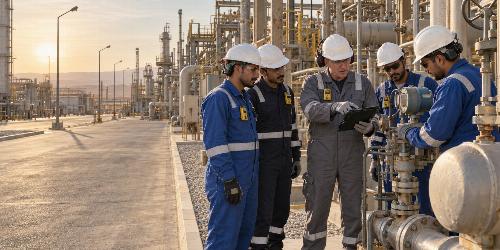
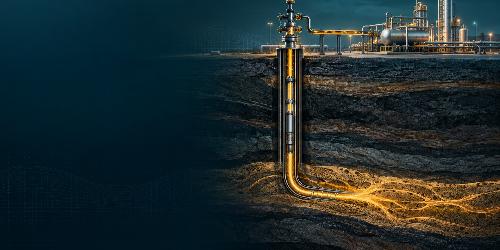
Production performance is created by a connected system rather than by a single discipline. Reservoir behavior, well architecture, completion choices, lift method, operating practices, flow assurance, surface constraints, integrity, economics, and risk all influence the production outcome. This programme gives multidisciplinary professionals a common technical framework for understanding those connections and participating effectively in production decisions.
The standard programme combines concept briefings, guided calculations, equipment reviews, diagnostic exercises, and an integrated asset case. It develops interpretation and screening capability rather than specialist design authority. Detailed equipment sizing, treatment design, and execution certification require discipline-specific advanced training and supervised field experience.
Business relevance of this training:
• Establishes a shared technical language across subsurface, wells, operations, facilities, projects, integrity, HSE, and commercial teams.
• Improves the quality of production opportunity identification, technical challenge, and cross-functional decision making.
• Helps participants distinguish symptoms from root causes and request the right data before recommending intervention.
• Builds awareness of lifecycle trade-offs among production rate, recovery, reliability, integrity, safety, cost, and emissions.
• Supports onboarding, role transitions, asset-team development, and preparation for more advanced production engineering courses.
• Geologists, geophysicists, petrophysicists, reservoir engineers, and reservoir technologists.
• Drilling, completion, intervention, well integrity, and well delivery personnel.
• Process, facilities, flow assurance, operations, maintenance, reliability, and HSE professionals.
• Asset managers, project engineers, planners, economists, commercial professionals, and technical team leaders.
• Service-company specialists and technical sales professionals supporting upstream operations.
- General familiarity with upstream oil and gas terminology or completion of an introductory petroleum industry course.
- Comfort with basic algebra, charts, units, and spreadsheet calculations.
- No prior production engineering or artificial lift design experience is required.
- Participants should complete the pre-course questionnaire so examples can be aligned with their assets and responsibilities.
- Explain the role of production technology professionals across the asset lifecycle and describe their interfaces with subsurface, wells, facilities, operations, integrity, HSE, and commercial teams.
- Trace the production system from reservoir to export and relate geological, reservoir, fluid, well, and surface conditions to production performance.
- Interpret simplified inflow and outflow relationships, locate the operating point, and use system analysis to identify likely constraints and useful sensitivity cases.
- Compare common artificial lift methods and make a screening-level recommendation using reservoir, well, fluid, facilities, operating, reliability, and economic criteria.
- Explain how completion architecture, formation damage, perforating, sand control, matrix stimulation, and hydraulic fracturing affect well deliverability and lifecycle risk.
- Recognize common production problem signatures, validate essential data, distinguish symptoms from plausible causes, and propose a structured diagnostic plan.
- Identify well-integrity, flow-assurance, process-safety, and environmental considerations that must be addressed before production changes or interventions are implemented.
- Evaluate selected modern production technologies at concept-screening level and identify the evidence required before field deployment.
- Communicate an integrated production opportunity, including assumptions, uncertainties, risks, alternatives, and expected value, to a multidisciplinary decision team.
- Responsibilities of production technologists and production engineers across concept selection, design, start-up, operations, optimization, intervention, and late-life management.
- Interfaces with geoscience, reservoir engineering, drilling, completions, facilities, operations, maintenance, integrity, HSE, projects, and commercial functions.
- The production opportunity lifecycle: identify, diagnose, screen, select, design, implement, verify, and sustain.
- Technical leadership without direct authority: framing decisions, exposing uncertainty, aligning stakeholders, and defining assurance requirements.
- Examples of production technology applications in oil, gas, gas-condensate, water-injection, onshore, offshore, conventional, and unconventional assets.
- Well purpose, trajectory, architecture, and the differences among exploration, appraisal, production, and injection wells.
- Onshore and offshore drilling environments, rig types, principal rig components, and the sequence of drilling operations.
- Hoisting, rotating, circulating, drilling-fluid, power, well-control, and blowout-prevention systems.
- Casing design intent, casing strings, cementing objectives, barrier verification, and wellhead installation.
- Drilling events that can influence productivity, including mud invasion, lost circulation, poor hole condition, cement quality, and well placement.
- Completion design objectives and the production operating envelope.
- Open-hole and cased-hole completions; single-zone, selective, commingled, horizontal, multilateral, and intelligent completion concepts.
- Tubing, packers, subsurface safety valves, landing nipples, flow-control devices, wellhead, and tree functions.
- Initial overview of perforating, formation damage, sand risk, stimulation, and water or gas control as completion design inputs.
- Completion selection trade-offs involving deliverability, zonal control, surveillance, intervention access, integrity, reliability, cost, and abandonment.
- Objectives of effective depletion: safe containment, sustainable deliverability, efficient recovery, manageable produced fluids and solids, and lifecycle value.
- Effects of structure, heterogeneity, porosity, permeability, saturation, pressure, temperature, drive mechanism, and fluid behavior on well performance.
- Conventional oil and gas, gas-condensate, tight and shale resources, and coalbed methane: major production differences.
- Inflow, tubing outflow, lift mechanics, gathering and facility constraints as parts of one production system.
- Field development choices, well count and placement, data acquisition, surveillance planning, uncertainty, and decision gates.
- Definition of system boundaries and nodes from reservoir to separator or injection source to reservoir.
- Oil- and gas-well inflow concepts, productivity index, inflow performance relationships, deliverability, skin, and rate-dependent effects.
- Tubing and flowline performance, pressure loss components, fluid properties, flow regimes, liquid holdup, and multiphase-flow correlation awareness.
- Construction and interpretation of inflow and outflow curves, the operating point, unstable or non-deliverable conditions, and facility backpressure.
- Sensitivity analysis for reservoir pressure, skin, tubing size, water cut, gas-liquid ratio, wellhead pressure, separator pressure, and lift input.
- Model quality: input validation, correlation selection, uncertainty ranges, calibration, and the limits of simplified analysis.
- Natural flow decline, liquid loading, drawdown management, and the objectives of artificial lift.
- Screening criteria: depth, trajectory, casing and tubing, rate, pressure, fluid viscosity, gas fraction, solids, temperature, corrosivity, power, injection gas, access, environment, and footprint.
- Overview of sucker-rod pumps, progressing cavity pumps, jet pumps, plunger lift, gas lift, and electrical submersible pumps.
- Reliability, surveillance, intervention frequency, energy efficiency, emissions, operability, spares, workforce capability, and lifecycle economics.
- Hybrid and staged lift strategies as reservoir pressure and fluid composition change.
- Sucker-rod pumping: surface unit, rod string, downhole pump, load path, pump fillage, fluid pound, gas interference, rod and tubing wear, and design sensitivities.
- Progressing cavity pumping: rotor and stator, elastomer compatibility, torque, speed, gas and solids handling, temperature limitations, and failure signatures.
- Jet pumping: nozzle and throat, power-fluid circuit, surface equipment, retrievability, efficiency, and applications in deviated or difficult wells.
- Plunger lift: operating cycle, candidate selection, liquid loading, pressure and rate requirements, controller logic, and surveillance.
- Operational optimization, failure data, troubleshooting logic, and the boundary between screening and detailed design.
- Gas lift applications, continuous and intermittent lift, injection-gas availability, unloading, operating valve depth, mandrels, valves, surface control, and compression interfaces.
- Using inflow and tubing sensitivities to understand injection depth, injection rate, tubing size, wellhead pressure, instability, and production targets.
- Gas lift surveillance and optimization: pressure surveys, temperature, acoustic and production data, allocation, valve performance, and multiwell gas distribution.
- Electrical submersible pump system components: pump stages, intake, gas handling, seal or protector, motor, cable, downhole sensors, wellhead penetrator, transformer, and variable-speed drive.
- Pump performance curves, operating range, head and rate matching, free gas, solids, scale, temperature, cooling, power quality, start-up, and shutdown considerations.
- Failure reporting, teardown evidence, root-cause analysis, and using reliability data to improve future selection and operation.
- Damage mechanisms associated with drilling, completion, cementing, perforating, workover, injection, production, fluids, fines, clays, scale, emulsions, and biological activity.
- Near-wellbore permeability impairment, mechanical or completion restrictions, apparent skin, and the practical distinction between formation damage and other performance limitations.
- Diagnostic evidence from history, pressure and rate response, fluid samples, well tests, logs, intervention records, and system analysis.
- Matrix treatment objectives, candidate selection, injectivity, compatibility testing, diversion, placement, treatment monitoring, and post-job evaluation.
- Carbonate acidizing and sandstone acidizing: different reaction mechanisms, chemical systems, operational hazards, and common failure modes.
- Perforating objectives, shaped-charge components, gun configurations, conveyance methods, shot density, phasing, penetration, entry-hole size, underbalance and overbalance, debris, and operational risk.
- Sand production mechanisms, consequences, prediction uncertainty, drawdown and rate management, selective completion, and surface sand handling.
- Standalone screens, premium screens, expandable screens, open-hole and cased-hole gravel packs, frac packs, placement concepts, screen-out risk, and basic gravel sizing principles.
- Hydraulic-fracturing fundamentals: stress, elastic response, fracture initiation and propagation, geometry, conductivity, leakoff, treatment pressure, fluids, proppants, and diagnostics.
- Propped fracturing and fracture acidizing; differences among conventional sandstone, carbonate, tight, and unconventional shale applications.
- Integrated selection: productivity objective, completion geometry, sand risk, formation damage, reserves exposure, execution risk, integrity, water management, and economics.
- Minimum surveillance dataset: rates, pressures, temperatures, fluid properties, allocation, downtime, interventions, well tests, equipment status, and data confidence.
- Drill-stem, production, build-up, drawdown, injectivity, and interference tests at awareness level; matching test choice to the diagnostic question.
- Common signatures of reservoir depletion, skin change, liquid loading, water or gas breakthrough, scale, wax, asphaltene, hydrates, corrosion, erosion, sand, leaks, restrictions, and lift-equipment degradation.
- Using system analysis, pressure profiles, trend plots, vertical and horizontal well considerations, and uncertainty ranges to test hypotheses.
- Root cause versus symptom; diagnostic trees; remediation screening; production impact, execution risk, cost, and verification plan.
- Well integrity throughout the lifecycle: barrier elements, operating limits, annulus monitoring, management of change, intervention interfaces, and escalation.
- Wellhead-to-export system: chokes, manifolds, gathering lines, separation, dehydration, compression, pumping, produced-water handling, water injection, metering, and export constraints.
- Flow assurance and operability: temperature and pressure envelope, hydrates, wax, scale, slugging, erosion, corrosion, chemical injection, restart, turndown, and transient operations.
- Onshore and offshore system differences; subsea wells, trees, flowlines, risers, control systems, access, reliability, and intervention constraints.
- Smart completions and smart fields: downhole flow control, permanent sensing, multiphase metering, automated surveillance, optimization workflows, and data-quality requirements.
- Selected applications including expandable tubulars, swellable packers and elastomers, chemical water shutoff, mechanical isolation, conformance control, and advanced surveillance.
- Technology screening: problem definition, maturity, compatibility, assurance, value case, pilot design, deployment, benefit verification, and lessons learned.
- Integrated capstone covering production diagnosis, well-performance analysis, lift or intervention screening, facility constraints, integrity and HSE risk, economics, and stakeholder communication.
Training can take place in 4 formats:
- Self-paced
- Blended learning
- Instructor-led online (webinar)
- Instructor-led offline (classroom)
Description of training formats:
- Self-paced learning or e-Learning means you can learn in your own time and control the amount of material to consume. There is no need to complete the assignments and take the courses at the same time as other learners.
- Blended learning or "hybrid learning" means you can combine Self-paced learning or e-Learning with traditional instructor-led classroom or webinar activities. This approach requires physical presence of both teacher and student in physical or virtual (webinars) classrooms or workshops. Webinar is a seminar or presentation that takes place on the internet, allowing participants in different locations to see and hear the presenter, ask questions, and sometimes answer polls.
- Instructor-led training, or ILT, means that the learning can be delivered in a lecture or classroom format, as an interactive workshop, as a demonstration under the supervision and control of qualified trainer or instructor with the opportunity for learners to practice, or even virtually, using video-conferencing tools.
When forming groups of students, special attention is paid to important criteria - the same level of knowledge and interests among all students of the course, in order to maintain stable group dynamics during training.
Group dynamics is the development of a group in time, which is caused by the interaction of participants with each other and external influence on the group. In other words, these are the stages that the training group goes through in the process of communicating with the coach and among themselves.
The optimal group size for different types of training:
- Self-paced / E-learning: 1
- Instructor-led off-line (classroom): 6 – 12
- Instructor-led on-line (webinar): 6 – 12
- Blended learning: 6 – 12
- Workshop: 6 – 12
- On-the-job: 2 – 4
- Simulator: 1 – 2
Feedback in the form of assessments and recommendations is given to students during the course of training with the participation of an instructor and is saved in the course card and student profile.
In order to control the quality of the services provided, students can evaluate the quality and training programme. Forms of assessment of the quality of training differ for courses with the participation of an instructor and those that are held in a self-paced format.
For courses with an instructor, start and end dates are indicated. At the same time, it is important to pay attention to the deadlines for passing tests, exams and practical tasks. If the specified deadlines are missed, the student may not be allowed to complete the entire course programme.
A personal account is a space for storing your training preferences, test and exam results, grades on completed training, as well as your individual plan for professional and personal development.
Users of the personal account have access to articles and blogs in specialized areas, as well as the ability to rate the completed training and leave comments under the articles and blogs of our instructors and technical authors
Registered users of a personal account can have various roles, including the role of a student, instructor or content developer. However, for all roles, except for the student role, you will need to go through an additional verification procedure to confirm your qualifications.
Based on the results of training, students are issued a certificate of training. All training certificates fall into three main categories:
- Certificate of Attendance - students who successfully completed the course but did not pass the tests and exams can apply for a certificate of attendance.
- Certificate of Completion - students who have successfully completed a course could apply for a Certificate of Completion, this type of certificate is often required for compliance training.
- Verified Certificate - it is a verified certificate that is issued when students have passed exams under the supervision of a dedicated proctor.
You can always download a copy of your training certificate in PDF format in your personal account.
You will still have access to the course after completing it, provided that your account is active and not compromised and Tecedu is still licensed for the course. So if you want to review specific content in the course after completing it, or do it all over again, you can easily do so. In rare cases, instructors may remove their courses from the Tecedu marketplace, or we may need to remove a course from the platform for legal reasons.
During the training, you may encounter various forms of testing and knowledge testing. The most common assessment methods are:
- preliminary (base-line assessment) - to determine the current level of knowledge and adapt the personal curriculum
- intermediate - to check the progress of learning
- final - to complete training and final assessment of knowledge and skills, can be in the form of a project, testing or practical exam
Travel to the place of full-time training is not included in the cost of training. Accommodation during full-time studies can be included in the full board tuition fees.
While Tecedu is not an accredited institution, we offer skills-based courses taught by real experts in their field, and every approved, paid course features a certificate of completion or attendance to document your accomplishment.
You can preview samples of the training materials and review key information about the course on our website. You can also review feedback and recommendations from students who already completed this course.
We want you to be happy, so almost all purchased courses can be returned within 30 days. If you are not satisfied with the course, you can request a refund, provided the request complies with our return policy.
The 30-day money back policy allows students to receive quality teaching services with minimal risk, we must also protect our teachers from fraud and provide them with a reasonable payment schedule. Payments are sent to instructors after 30 days, so we will not process refund requests received after the refund period.
We reserve the right, in our sole discretion, to limit or deny refund requests in cases where we believe there is refund abuse, including but not limited to the following:
- A significant portion of the course has been consumed or downloaded by a student before the refund was requested.
- Multiple refunds have been requested by a student for the same course.
- Excessive refunds have been requested by a student.
- Users whose account is blocked or access to courses is disabled due to violation of our Terms and Conditions or the Rules of Trust and Security.
- We do not grant refunds for any subscription services.
- These refund restrictions will be enforced to the extent permitted by applicable law.
We accept most international credit and debit cards like Visa, MasterCard, American Express, JCB and Discover. Bank Transfers also may be an option.
Conducting classes is based on the fact that the teacher demonstrates text, drawings, graphics, presentations on an interactive board, while the content appears in the student's electronic notebook. A specially designed digital notepad and pen are used to create and edit text and images that can be redirected to any surface via a projector.
Classes are live streamed online, automatically recorded and published on the Learning Portal, allowing you to save them for reuse anytime, anywhere, on any mobile device. This makes it possible not to miss classes and keep up with classes and keep up with the passage of new material.
Real-life training uses the principles of game organization, which allows future professionals to rehearse and hone their skills in a virtual emergency. Learning as a game provides an opportunity to establish a connection between the learning activity and real life.
The technology provides the following learning opportunities:
- Focused on the needs of the user
- Instant feedback
- Independent decision making and choice of actions
- Better assimilation and memorization of the material
- Adaptive pace of learning tailored to the individual needs of the student
- Better transfer of skills learned in a learning situation to real conditions
Basic principles of training:
- A gradual increase in the level of difficulty in the game;
- Using a simplified version of a problem situation;
- Action in a variable gaming environment;
- The right choice is made through experimentation.
The main advantages of Game Based Learning technology:
- Low degree of physical risk and liability
- Motivation to learn while receiving positive emotions from the process;
- Practice - mirroring the real situation
- Timely feedback
- Choice of different playing roles
- Learning in collaboration
- Developing your own behavior strategy
Conducting practical classes online using remote access technologies for presentations, multimedia solutions and virtual reality:
- Laboratory workshops that simulate the operation of expensive bench equipment in real production
- Virtual experiment, which is visually indistinguishable from a remote real experiment performed
- Virtual instruments, which are an exact copy of real instruments
- Mathematical modeling to clarify the physical characteristics, chemical content of the investigated object or phenomenon.